
What is acrylic solid surface? Uses, sizes and colours
Acrylic solid surface is a sheet of acrylic resin and mineral fillers with the colour running through its full thickness. Pieces can be joined and shaped, so a counter, vanity or desk can look like one continuous piece. At Inlife it is shown in 6 mm and 12 mm sheets.
What it is
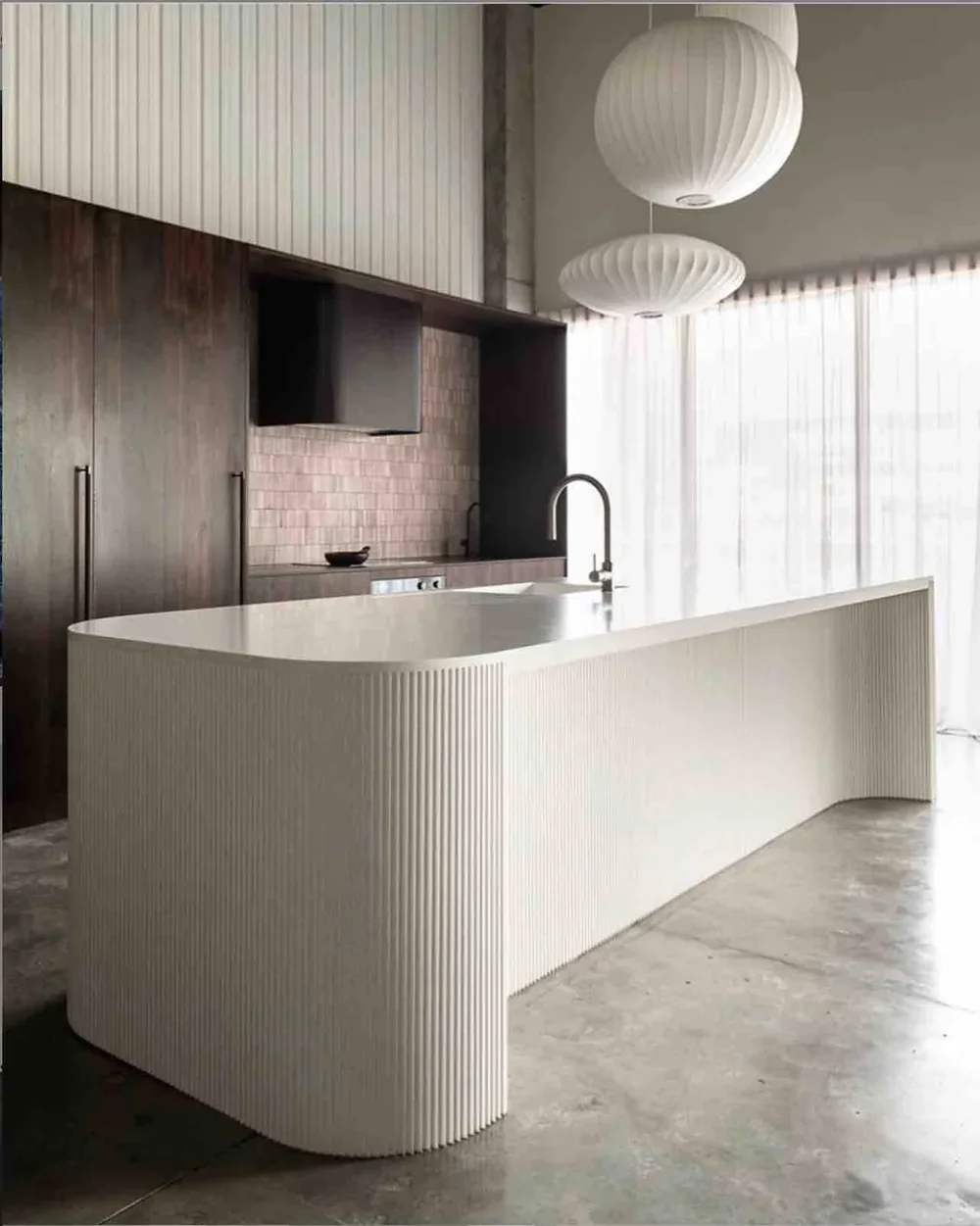
Acrylic solid surface is a sheet made of acrylic resin, mineral fillers and pigments. The colour runs through the full thickness of the sheet rather than sitting on top, so an edge, a cut-out or a routed groove shows the same colour as the face. Pieces can be joined so the seam is hard to see, and the sheet can be shaped, which is why it turns up on curved reception desks and integrated basins. For the Tristone colour families and sheet sizes, see Tristone colours and sheet sizes.
At Inlife the range is shown in 6 mm and 12 mm sheets, in solid colours, fine speckles and granite-look chips. Some shades come in 12 mm only. The Tristone library is the range on display; for the colours themselves see the Tristone page.
The short version: it is a material for surfaces that should read as one piece. If your design depends on a long, unbroken top, a curved front or a basin that rises out of the counter, this is the family to look at first.
How it differs from laminate, stone and acrylic sheet
The difference shows in three places: how the face looks, what format it arrives in, and how the joins read.
| Laminate | Natural stone | Acrylic solid surface | |
|---|---|---|---|
| Face | A printed decorative layer | Natural veining, varies slab to slab | Colour through the sheet; plain, fine speckle or granite-look chips |
| Format | Pressed onto a board | Cut from a block into slabs | Thick sheets, 2500 × 760 mm or 3680 × 760 mm |
| Edge | Shows the board layer | Shows the stone, polished or profiled | Shows the same colour as the face |
| Joins | Break in the pattern | Slabs meet at a visible line | Can be made hard to spot |
| Shape | Flat | Cut and polished | Cut, routed and shaped into curves |
Acrylic solid surface is also not the thin acrylic sheet used on shutters. That sheet is about 1.3 mm thick and faces a board. Solid surface is a thick sheet that forms the counter or desk itself.
It feels different in the hand. The surface is smooth with a satin sheen, less glossy than glass or polished stone.
In a room, the practical consequence is sightlines. A laminate counter shows a board edge from the side, a stone counter shows a seam where slabs meet, and a solid surface counter can show neither. Walk round the piece in your mind from the door, from the seating and from the side. If any of those views would be spoiled by a visible line, solid surface is worth a look.
Sheet sizes and thickness
The 6 mm sheet is 2500 × 760 mm, about 20.45 sq ft. The 12 mm sheet is 3680 × 760 mm, about 30 sq ft. Some shades are made in 12 mm only.
- 12 mm is the usual choice for kitchen counters, vanity tops, desks and bar tops.
- 6 mm suits wall designs, cladding and other vertical surfaces.
Both sheets are 760 mm wide, so check your counter depth against that early. Long sheets help on long runs, such as an island or a reception counter, because fewer joins are needed. Fewer joins is a look decision as much as a practical one: a long top with one join reads as a single object.
Where it suits
The product is shown for kitchens, bathrooms, offices, healthcare and hospitality. The uses that follow from that:
- Kitchens. Counters and backsplashes that run without a visible joint, including around a sink.
- Bathrooms. Vanities and wash basins shaped as one piece with the top.
- Reception and retail. Desks, bar tops, display counters and tabletops, including curved forms.
- Healthcare and offices. Nurse stations, laboratory counters, work counters and service desks.
- Walls and partitions. Cladding and partitions in large panels, with no grout lines.
- Furniture and displays. Tables, shelving, temple tables, display plinths and shop signage, where a smooth, continuous surface is the point.
Pick the use first, then the thickness. A counter, vanity or desk is a 12 mm decision. A wall is a 6 mm decision. Mixing the two in one room is common: a 12 mm desk with a 6 mm wall panel behind it, in the same shade, reads as one composition.
For counters and reception desks in particular, see Tristone - acrylic solid surface in India.
The colour range
- Whites. Pure White, Snow Pearl and soft off-whites, for an all-white counter with nothing breaking it up.
- Warm neutrals. Creams and sands such as Beige Cream, Irish Cream and Beige Sands.
- Greys. From pale Fog to Metal Grey and Grey Ash.
- Deep tones. Espresso, Night Sky, Dark Cave and Onyx.
- Bold colours. Mango, Sunset, Aquamarine and Emerald Sherbet, for counters and furniture that should be noticed.
Within these tones the surface may be plain, finely speckled or patterned with larger granite-look chips. Plain colours give the simplest look. Fine speckles break up the surface a little and sit well beside stone and wood. Granite-look chips suit counters that sit next to natural stone.
Choose the family by where the surface sits in the room. A large kitchen island is read as a big, flat plane, so a plain or finely speckled shade keeps it from competing with the floor. A small vanity can take a deeper shade, because there is less of it to see. A reception desk is seen from the door, so a deep or bold colour gives it presence. Bold colours reward restraint: one bold counter against neutral walls reads as a decision.
Designing with solid surface
Make use of the fact that it joins and shapes. An island can turn down at the end into a vertical side. A basin can be formed out of the vanity top, and a reception desk can follow a curve on plan. Stone and laminate are not worked this way.
Walls are the other opportunity. Large 6 mm panels give a wall face with no grout lines, which suits a feature wall behind a desk or a counter that continues up as a backsplash in the same shade.
Lighter shades can be lit from behind, which is often done on bar fronts and reception desks. A lit front makes the colour paler and the form flatter, so ask to see backlit samples before choosing the shade.
Seeing it at the Choolai showroom
Visit Inlife - Nakoda Creations, 2 Baker Street, Choolai, Chennai, Monday to Saturday, 10 am to 8 pm. Catalogues are shared on WhatsApp across India, and samples can be sent to offices in Chennai only, up to 12 per request.
- Bring a laminate, tile or timber sample you have already chosen, and the length and depth of the surface.
- View large pieces, not small chips. A speckle looks different across a full counter.
- Compare the shade against your sample by daylight and again under indoor light.
- Check the edge to see the colour carries through.
Questions people ask
What is acrylic solid surface made of?
Acrylic resin blended with mineral fillers and pigments. The colour runs through the full thickness of the sheet.
What size are the sheets and which thickness suits a counter?
2500 × 760 mm at 6 mm, about 20.45 sq ft, and 3680 × 760 mm at 12 mm, about 30 sq ft. The 12 mm sheet is the usual choice for counters, vanity tops and desks. The 6 mm sheet suits walls.
Which brand of acrylic solid surface does Inlife carry?
Nakoda Creations is the only pan-India distributor of Tristone, from Lion Chemtech Co., Ltd., South Korea.
Can acrylic solid surface be curved?
Yes, it can be shaped, which is why it is chosen for curved desks, counters and integrated basins.
Is acrylic solid surface the same as an acrylic sheet?
No. Acrylic sheets for shutters are about 1.3 mm thick and face a board. Solid surface is a thick sheet that forms the counter or desk itself.